
Joan of Arc
The “Joan of Arc” is a statue of the legendary French Catholic saint and heroine of the Hundred Years War. The original commission for the statue of "Joan of Arc" was by Napoleon the third. It was originally intended to reestablish French confidence after being defeated by the Prussian army in 1870. Emmanuel Frémiet was chosen for this commission since he was well known for incorporating human and animal motifs in a neo realistic manner within his statues.

The question is, how did it end up in Philadelphia? Well, the French society of Philadelphia with the help of the Fairmount Park Association, wanted to commemorate their centennial, so they arranged to purchase a cast of the original Joan of Arc statue from the artist. They made a contract with the artist that there would be only three cast of this sculpture: the one in Place des Pyramides, the one in Philadelphia, and another one in France in the town of Nancy.


Who was Joan of Ach
St. Joan of Arc is a well-known icon within history, art history, and Catholicism. St. Joan is considered one of the most heroic people in France. She's revered as a holy person with her courage and faithfulness. At the age of 14 she began to hear the voices of angels telling her that if she didn't go into battle, the king of France would be killed. After multiple times of speaking to the logo commander of the French army, she was sent to King Charles VII. After analysis by theologist, they found her speaking truthfully about the messages she was receiving from the angels and was put front line into battle. She marched into battle with a banner that proclaimed the names of Jesus and Mary. Within 10 days, the siege was broken. Even though she was wounded by an arrow, she pressed on with the army to other regions and routed her opponents. Her victory regained the bulk of the kingdom of France from the intruders and concluded the mission that was entrusted to her by the voices she heard. She predicted all of these events before any of them happened. Even though she was successful in her first battle, she lost many battles afterwards and was eventually put on trial and executed at the age of 17.

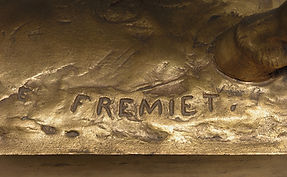
Emmanuel Fremiet 1824- 1910
Fremiet was a Franch sculpturer who devoted himself to animal sculpture and to equestrian statues in armor. His earliest work was in scientific lithography (osteology), and for a while he served in times of adversity in the gruesome office of painter to the Morgue. From 1855 to 1859, Frémiet was engaged on a series of military statuettes for Napoleon III. Frémiet produced his equestrian statue of Napoleon I in 1868, and of Louis d' Orlans of 1869 at the Château de Pierrefonds and in 1874 the first equestrian statue of Joan of Arc, erected in the Place des Pyramides.

Frémiet studied the design of fifteenth-century French armor and dress in order to convey the figure within Joan's historical context. Her proper right hand is raised and she holds up a flag in her proper right hand. In her proper left hand she holds the reins. She is crowned with a laurel wreath and clothed in armor. A sword hangs by her proper left side. The horse is walking with its front, proper left and rear, proper right hooves raised.


Today
In 1948 the Association relocated the sculpture to its present site near the Philadelphia Museum of Art and gilded it in gold in 1960. In 2009, it was removed for restorations to repair a crack that appeared a crack and re-gilded and returned to its current spot in 2010.