

LOVE
The LOVE statue is Philly’s most iconic statue; it was created by Robert Indiana. It was originally a screen print made during the Pop Art movement. “LOVE” first appeared in a series of poems written by Indiana.

The first appearance of LOVE was on MoMA's annual Christmas card. The color scheme was inspired by his father working at a gas company. Indiana said "The 'LOVEs' all come from the fact that my father worked for Phillips 66.
Indiana said "The 'LOVEs' all come from the fact that my father worked for Phillips 66. My mother would drive my father to work and pick him up. We would pass the Phillips 66 station with a huge circular sign in the sky. The gas pumps were red and green, the uniforms were red and green, the oil cans were red and green, and so the red and green Phillips 66 sign against the blue sky is why the first love was red, blue, and green,

. “LOVE” color scheme may also have been inspired by Ellsworth Kelly’s painting “Red, Blue, Green” for its simple color pattern. “LOVE” is not the first and only one of its kind. There are many spread across America: New York, Indiana, Nashville and more.


Artist: Robert Indiana (1928-2018)
Robert Indiana was born in New Castle, Indiana played a central role in the development of assemblage art, hard-edge painting, and Pop art. Indiana, a self proclaimed “American painter of signs,” created a highly original body of work that explores American identity, personal history, and the power of abstraction and language. Although acknowledged as a leader of Pop, Indiana distinguished himself from his Pop peers by addressing important social and political issues and incorporating profound historical and literary references into his works.
The creation LOVE park
After the Second World War Edmund Bacon wanted to revamp the downtown Philadelphia after, decades of depression and war. Bacon wanted to make it more modernizes so, he had the "Chinese wall" demolish. The "Chinese Wall" was a giant railroad. The Park was named JFK in honor after his assassination in 1963.

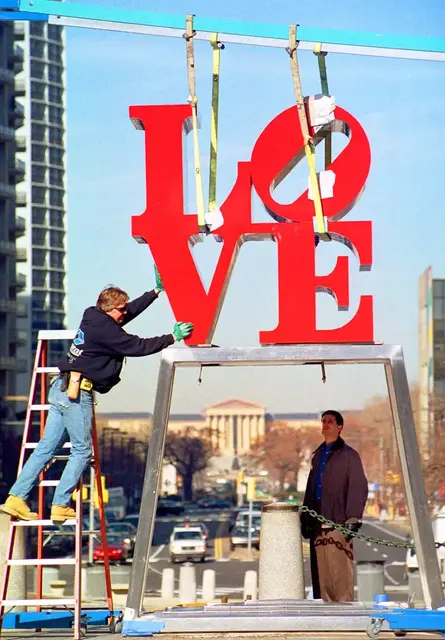
Getting the LOVE statue back to Philly
Indiana loaned the work to Philadelphia for the Bicentennial, Then LOVE was swept away. When the artist’s dealer recalled the sculpture to New York for a potential buyer in 1978, a public outcry ensued. City officials, who admitted to having no knowledge of the art market, had declined to pay the $45,000 asking price to keep LOVE in the park. Ultimately the price came down to $35,000, paid as a donation by Fitz Eugene Dixon Jr., owner of the Philadelphia 76ers basketball team and chairman of the Philadelphia Art Commission. The Quaker Export Packaging Company donated its labor to retrieve the lost LOVE.
LOVE today
The "LOVE" statue resides in JFK park aka LOVE park. The Philadelphia version is 6 feet which sits on a 13-foot-tall platform. It is made of polychrome aluminum then painted red, green, and blue. There was restoration on the statue and instead of blue it was originally purple. It naturally became apart Philly almost like the heart of center city. If you love the "LOVE" statue you also visit the "AMOR" statue in Philly.
